2026 - Volume #50, Issue #2, Page #27
[ Sample Stories From This Issue | List of All Stories In This Issue | Print this story
| Read this issue]
Kiwifruit Used To Make Leather Alternative
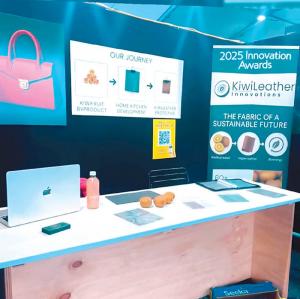 |

“My son worked in the kiwifruit industry, and his job was getting rid of kiwifruits unfit for the market,” says Houston. “He’d send me videos of the waste, and I couldn’t believe the amounts. More than 50,000 lbs. are rejected in New Zealand every year.”
Houston began exploring alternative uses and experimenting in her kitchen. She developed a proprietary formula that has advanced to a prototype and is nearing the pilot-plant stage.
“We process the waste kiwifruit into a pulp and, through a controlled process, create flexible sheets that mimic the look, feel and durability of leather,” says Houston. “The material is non-toxic, largely bio-based, and designed to meet the performance requirements of fashion, automotive and upholstery markets.”
Houston worked with Scion, now the New Zealand Institute for Bioeconomy Science, to develop the product.
“The goal is for the final product to be over 90% bio-based, as well as biodegradable,” says Angelique Greene of Scion.
Challenges included sugar content, flexibility, durability, and water resistance. The high sugar content can caramelize, preventing the absorption of other components. The researchers found that kiln-drying the pulp at low temperatures resolved this issue.
The team experimented with components such as soy and pea to increase the material’s strength. They also explored bio-based epoxidized soybean oil or cashew nut resin to achieve more plastic-like properties, and examined adding a fibrous backing to improve flexibility and enhance strength and resilience. Natural coatings are also being considered for water resistance.
Houston notes that the company is preparing for pilot-plant production and for regulatory and performance validation. In anticipation of approvals, product samples are being validated and tested by potential users. Early prototypes made with KiwiLeather include handbags, footwear components and interior trims.
“At scale, our pricing is expected to be competitive with premium animal leather and high-end plant-based alternatives,” says Houston. “Because our raw material is agricultural waste rather than purpose-grown crops, we avoid many of the land, water and time costs associated with both livestock leather and other plant-based leathers.”
As production volumes increase, Houston anticipates further cost efficiencies. This will create an additional revenue opportunity for growers and packhouses that supply waste fruit.
Houston notes that although the company is still in the pilot-plant stage, discussions have already been held with international brands and partners in the U.S. and Canada.
Kiwifruit may be just the beginning for Houston and her leather-like product.
“While kiwifruit is our primary feedstock, as it’s particularly abundant here, the underlying platform technology can be adapted to other fruit and agricultural waste streams,” says Houston. “We see strong potential for regional customization, where different countries could use their own local waste crops while applying the same core process.”
Contact: FARM SHOW Followup, Shelley Houston, KiwiLeather Innovations, Ltd. (ph +64 21 901 202; shelley@kiwileatherinnovations.com; www.kiwileatherinnovations.com).
Click here to download page story appeared in.

Click here to read entire issue
To read the rest of this story, download this issue below or click here to register with your account number.